Life Should Be Bittersweet
According to the Harvard School of Education (2023), “58% of young adults report experiencing little or no meaning or purpose in their lives in the past month. 29% report symptoms of depression, and 36% report anxiety.” In this two-part research paper, I explore the importance of boredom and mundanity in today’s fast-paced, digital world.
Claiming that spending less time on screens will lead to finding meaning in life is a vast oversimplification; however, I’d like to demonstrate its merit through evidence-based research and my own conjecture as an adolescent who has studied digital health for the past two years.
In this paper, I argue that the key to a healthy relationship with phones isn’t screen blockers or apps, but shifting how we experience excitement outside of screens. If we learn to enjoy mundane moments, we won’t need to turn to short-form content. The first thing noticed when putting this into practice is an unpleasant sense of boredom. Every feeling has its purpose, and the biggest mistake we make in today’s digital world is avoiding boredom. Being bored is how creativity, introspection, and our sense of meaning and purpose flourish.
The solution I’m describing isn’t new; it’s how people lived before phones. Now, the ups and downs of life become numbed when we seek avoidance. All to say, life shouldn’t be stale; it should be bittersweet.
PART I - the nuance of boredom
Digital Media's Entanglement in Daily Life
In the 1980’s, if you were a high school student, you would have likely seen police officers roll a CRT screen television in your classroom and play a tape of Nancy Reagan’s “Just Say No” mantra. The purpose of the first lady’s campaign was to combat the drug epidemic in the United States. Their campaign demonized all harmful substances under one umbrella and warned children to reject substance use before it’s available. In retrospect, the campaign’s messaging oversimplified the harmful effects of drug use, created more exposure than prevention, and is now largely seen as a failure. However, when connecting the Reagan administration’s initiative with the current state of screen time, there are a few lessons to be learned and distinctions to be made.
One, screen time is too broad a term. We know that excessive screen time negatively impacts well-being. Screens in general specify the means of consumption, not the medium. One could ask, are there differences between time spent watching television, playing video games, or among social media platforms such as Instagram or TikTok? Yes. There are cognitive nuances missed when placing different types of digital media under one umbrella. We would make the same mistakes as the Just Say No campaign, such as rejecting the use of screens in general. However, this conversation is not about one or two kids in the classroom, it’s about everyone who owns a phone.
But what if we did just say no to digital media? We commonly refer to this as a detox, and it marks another distinction: screens aren’t going anywhere. The prevalence of digital media in our daily lives is irreversible. This truth conflicts with the nature of a detox. The purpose of a detoxification from addictive behaviors is to abstain fully and quit. Meaning the benefits of a detox from digital media are largely enjoyed until those behaviors resume. When the exploitative design of social media returns, so too do its effects on the user’s well-being. For these reasons, it is crucial to prioritize your relationship with digital media, both on and offline.
Prioritizing your relationship with digital media is hard when tech companies sell products that live wherever you spend your time most, whether that’s your phone, tablet, smartwatch, e-reader, car display, desktop, streaming services, video games, or any “smart” appliance with a screen, app, and subscription service attached. For those reasons, simply going outside is a key intervention recommended at the end of this paper. However, even outside, we use our phones to make transactions, manage finances, navigate a GPS, scan documents, and communicate with others—emphasizing how entangled technology is in our daily lives. While we may lose the benefits of experiencing mundane moments by making utility more convenient (which I will talk about later), the susceptibility to shift attention from utility to content consumption is concerning. And it’s all about how we alleviate boredom.
What is Boredom?
Boredom, defined as “an aversive state of wanting to, but being unable to, engage in satisfying activities”, is a natural and unpleasant feeling. Like any emotion, it has its purpose and, when prolonged for too long, its harms. Similar to anxiety, boredom helps us regulate our thoughts, emotions, and behaviors. Boredom tells us that the current situation lacks meaning and fulfillment, leading our brain to crave some sort of change to generate interest. That change can be intrinsic, and is known as the Default Mode Network.
The Default Mode Network (DMN) describes the internal happenings in our brain when we are performing unengaging tasks. Our brain is incredibly smart, and it allocates attention in very optimal and sophisticated ways. When we perform goal-oriented tasks that are unengaging, the circuits in our brain responsible for our senses and working memory are deactivated, and the circuits responsible for self-referential thinking and memory retrieval activate (medial prefrontal cortex, posterior cingulate cortex, precuneus, inferior parietal lobules, and medial temporal regions). Think of constellations in the sky shifting in brightness depending on the context of what we’re doing.
Let’s say we started watching a movie that turned out to be super boring. It’s been half an hour, and you’ve rested your palm pressed against your cheek as you glare at the TV screen. From an outside point of view, it would look like you are consuming the content on screen, when in reality, you tuned out a while ago. Instead, you may be thinking about a plethora of things, such as how you spent your day, who you interacted with, and what you’ll do tomorrow. All of a sudden, you’ve been staring at the screen but would be unable to explain what it’s about. We’ve all experienced this “default mode”, or more commonly referred to as “being zoned out”. Some other scenarios may include washing the dishes or walking from your car to school or work.
The subjects explored during the default mode network don’t just include ordinary things, but it’s also when existential thoughts become the most prevalent. What is the meaning of life? Does money buy happiness? Did the chicken or the egg come first? These defining questions help formulate one’s values, beliefs, and identity, especially in the midst of influence and pressure during adolescence. Self-reflection, memories, daydreaming, and social evaluations are all functions of the DMN. Being deprived of such introspection hinders our ability to build a rich understanding of our sense of self and the world around us.
If you have already guessed, digital media is a major obstacle. Inattention is a characteristic shared by both boredom and the DMN. However, unlike the teenagers watching D.A.R.E. commercials in the 90s, our attention has become an exchanged good. The earlier example of the boring movie would have been realistic fifteen years ago, but now, the individual watching the film would have started scrolling on TikTok, quickly relieving the brain’s aforementioned craving. It’s hard to feel bored at all when social media and short-form content are accessible at our leisure at any moment. In fact, alongside internal cues, boredom relief is a primary motivator for digital media use. However, despite the accessibility of digital media, what if I told you that people are feeling more bored now than ever before?
How Digital Media Feeds Chronic Boredom
In 2024, Jonathan Haidt released his fourth published book: The Anxious Generation. He explored how social media causes mental illness in adolescents. It initiated a national conversation surrounding screen time, and it was my first major insight into how phones impact those around me. In it, he argued: “This is the great irony of social media: the more you immerse yourself in it, the more lonely and depressed you become.” In a later podcast, he said he grossly underestimated the role overstimulation plays in social media. Just like connection and isolation, social media often creates counterproductive feedback loops that leave us worse off than our sought value. In other words, the more engaged we are, the more bored we become – another great irony.
A 2008 to 2017 survey of U.S. secondary school students, found that there has been a rise in students agreeing with the item: “I am often bored,” rated on a five-point scale ( 1 = disagree, 5 = agree).
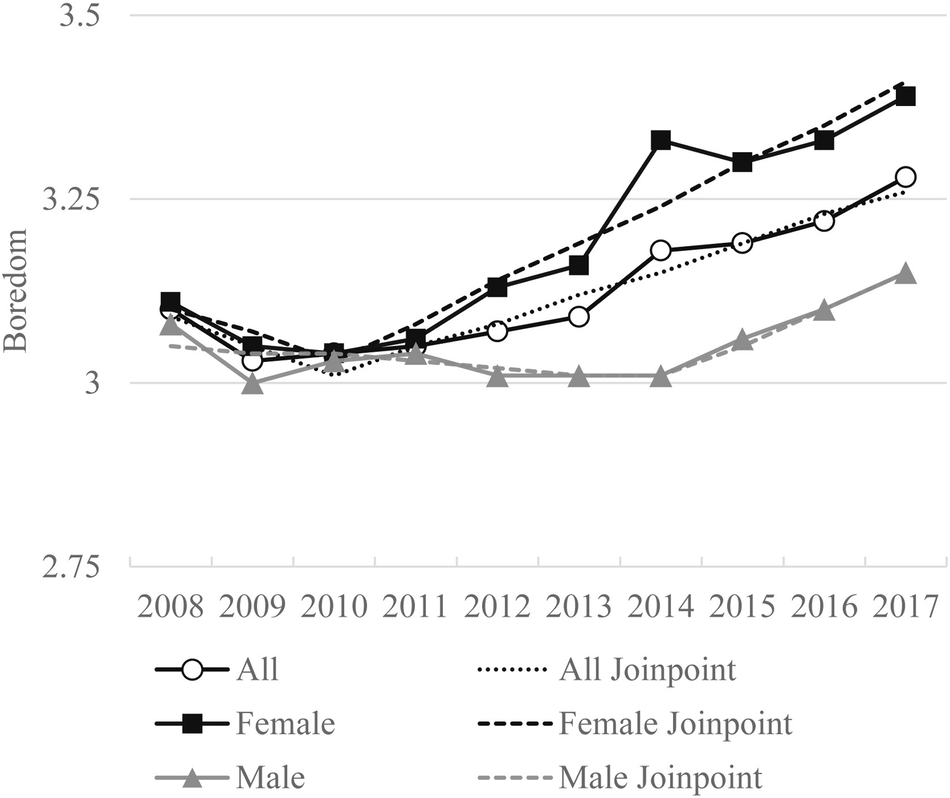
In a second study, researchers used the Boredom Proneness Scale, the most widely used measure for chronic boredom, and found that the average level of boredom in 2020 would have been considered unusually high in 2009. (Mean in 2009 = 50th percentile, mean in 2020 = near the 94th percentile.)
To further clarify, it makes sense that kids would be bored during COVID. However, the trends remain consistent leading up to the pandemic. According to the research paper, People are increasingly bored in our digital age, authors Katy Y. Y. Tam and Michael Inzlicht don’t argue that digital media is the only factor contributing to chronic boredom, and neither do I. They acknowledge that economic development, cultural shifts, and changes in social behaviors may play a role. However, similar to Jonathan Haidt’s discovery of rising mental illness in anglophone countries, chronic boredom has also risen in correspondence with the rise of social media throughout different countries. But how exactly does digital media increase boredom?
First, it’s important to define terminology and distinguish between ‘digital media’ and ‘social media’. Digital media encompasses the most general consumption of media on screens, including streaming services, streaming music, video games, news platforms, and social media platforms. Even among social media platforms, there are different types, such as image-based (Instagram) and short-form (TikTok). As platforms adopt different features, they can also create ambiguities. For example, while Roblox is primarily a video game, could it also be considered social media? This example leads to the main point: how online experience cultivates meaninglessness.
Would you rather have a lot of friends or one true best friend? Too little is harmful; loneliness makes social media’s promise of connection more appealing, but too much isn’t the answer either. Jonathan Haidt argued that the convenience of connecting with others on social media reduced the quality of those relationships, inadvertently making someone feel more isolated. The same holds true for engagement. When we are bored, when we lack fulfillment and meaning, we crave relief, so we scroll on TikTok or Reels. We scroll through bite-sized content that lacks coherence and presents an overwhelming amount of information, therefore diminishing meaning. Or one could label it– brainrot.
The pull and ‘stickiness’ of the novelty from these digital experiences qualify exploitation, especially when you understand the design within social media platforms. The research on the relationship between social media and dopamine closely aligns with this research on boredom. After all, boredom is the absence of dopamine. So then, why study boredom? Adolescents feeling more bored overall isn’t as concerning as what the evidence proves. Excessive screen time can lead to addiction, mental illness, social isolation, and sleep disorder. (How Social Media Exploits Adolescent Neurology, 2025) As a psychology nerd, the insight has been very beneficial in my daily life, and I’ve tested many practical applications. However, I was left feeling unsatisfied. I never wanted to inform others that spending too much time on your phone led to such serious consequences, and I didn’t believe addressing those consequences would lead to better health. I hoped for a better and more accessible solution, one that targeted the underlying problem. Unbeknownst to me, the answer revealed itself from the very questions that inspired this paper. And it requires…
PART II - finding the mundane again
Next time you are bored and pick up your phone for leisure, ask yourself: “What am I losing from avoiding boredom and the mundane? What is lost when I’d rather scroll on a screen than watch the trees passing by through the car window? Would I feel stillness if I knew my phone wasn’t in my pocket?”
Why Old Technologies Will Never Be Obsolete
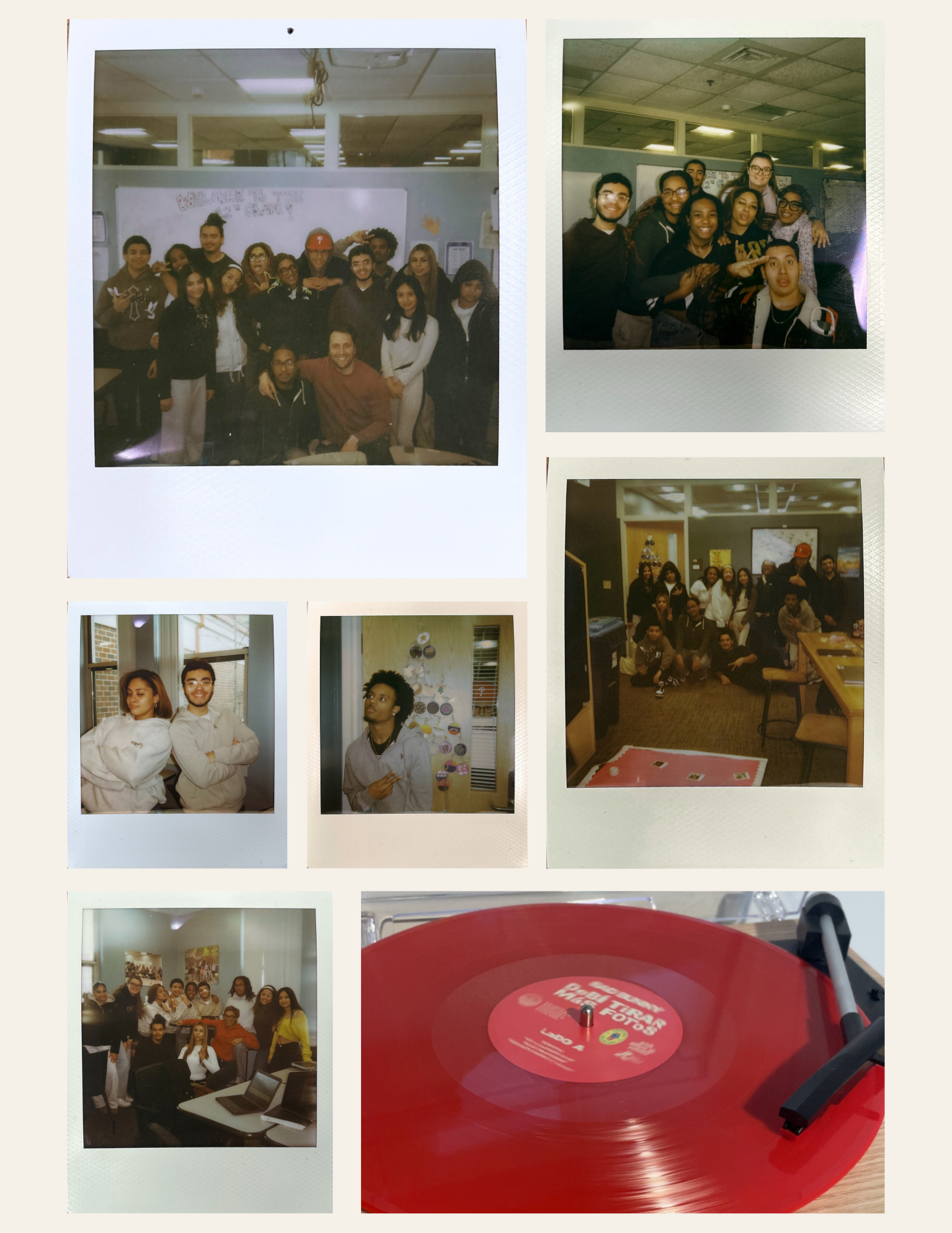
Two years ago, I got a vinyl record player for Christmas. I have zero nostalgia for vinyl records, but it piqued my interest. There was something about the experience of holding a 12” by 12” record, sliding it out of its sleeve, placing it on the turntable, and carefully letting the needle delicately touch the vinyl. The very moments between choosing to play music and hearing it felt special with vinyl records that were virtually eliminated with the ease of use of modern streaming.
This Christmas, I received another analog item, a Polaroid camera. While the camera itself is a hollow, plastic box, the real magic is the film. When you take a picture, the chemical reaction created by the light reacts in real time. Without a screen to see how you look and with the cost of each film, you are striving to create a lasting moment, not a perfect picture. That’s what happened when I brought it to school. We shot many photos with the Polaroid and collected pictures of one another that we can hold, touch, and cherish forever.
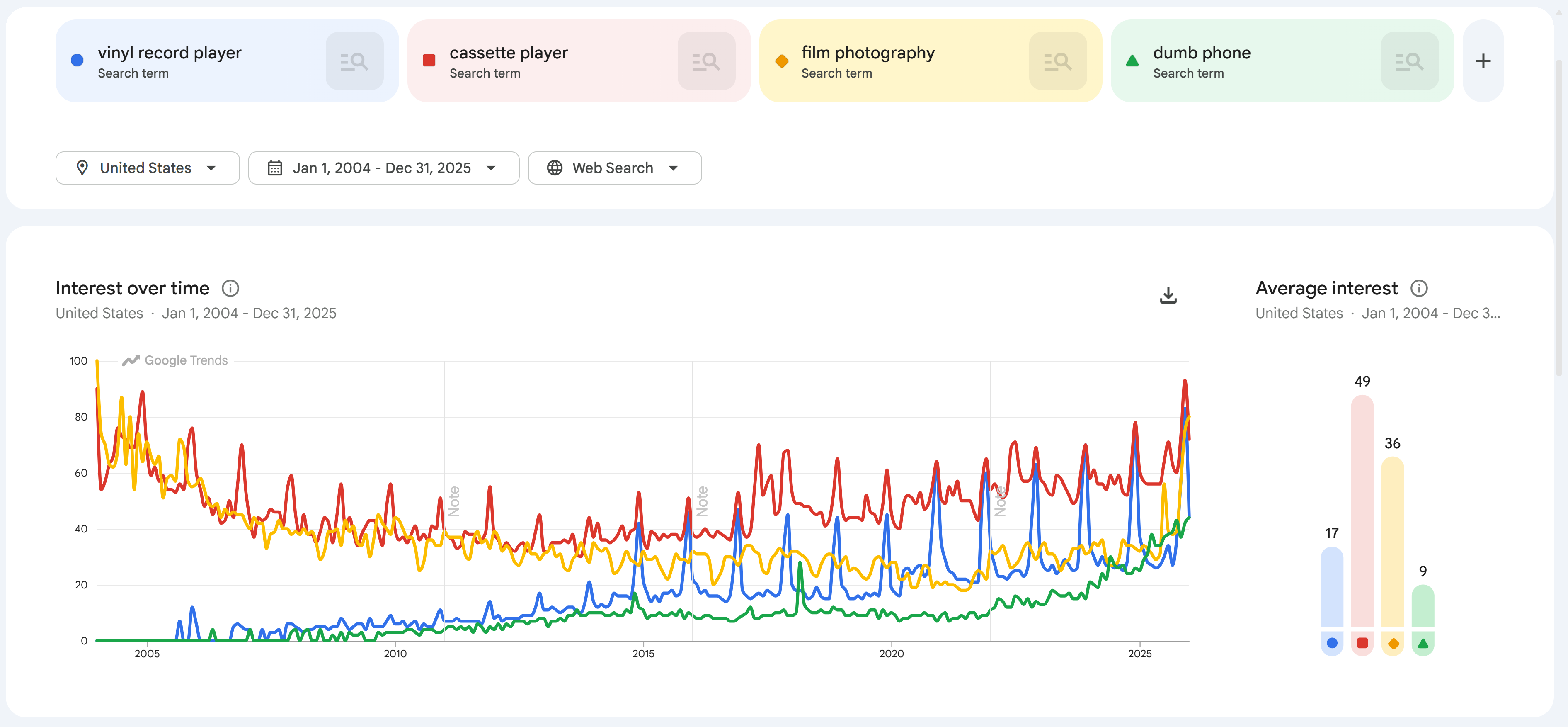
Now that digital technology is entangled in our society, the slowness of analog has risen as a trend. A novelty not just enjoyed by me, but by my generation as a whole. According to Google Trends, the search terms ‘vinyl record player’, ‘cassette player’, ‘film photography’, and ‘dumb phone’ have all peaked at their highest levels in December 2025 since the early 2010s, and, in the case of vinyl, since 2005. The rising popularity of retro and analog technology was also recognized by the Global Wellness Summit in their Future of Wellness 2025 Report. Their research director, Beth McGroarty, said that the trend “may be fueled by a human desire for tactile experiences rather than by nostalgia.” (CNBC, From Polaroid to Vinyl, Gen Z is Embracing Retro Tech) Could there be more to this trend than a mere novelty? Or do analog technologies offer practical benefits?
Analog technology is less convenient and much more expensive. One element of the appeal is ownership. Subscription-based streaming services lease your favorite movies, TV, and music. However, you don’t own the media you enjoy. Even if you purchase media on Apple TV or Kindle, you consent to their right to revoke any media you buy. Additionally, the market is consolidated to a select few platforms, attributed to ethically questionable royalties to artists. ($0.003-$0.005 per stream to artists on Spotify)
Another element of the appeal to analog technology is intention. It’s no secret that phones are very distracting. According to Common Sense Media, young people receive a median of 237 notifications in a typical day - a quarter of which arrive during the school day. While analog devices allow you to unplug, they don’t distract you from their intended purpose. There is no feature in a record player that will distract you from its only intended purpose for listening to music. The original iPhone in 2007 combined six devices into a single form factor that fits in your pocket. However, with the proliferation of the attention economy, that convenience is now utilized against the user for corporate profit. This nature led to the trend of “decentralizing the phone”. Many influencers online have created content about their anecdotes of carrying a notebook, camera, mp3 player, and standalone watch, enabling more user agency between convenience and intention.
The third and final appeal to analog technology is intimacy. If Gen Z and Millennials never grew up interacting with vinyl records, why has the market grown? Why not save time if playing music and taking photos is faster digitally? Don’t those mundane moments we save add up? They do. However, what is lost when we rid ourselves of those mundane moments? The rest of this paper explores the value of mundanities that are now lost to phones and social media.
I don’t intend to vilify or diminish the convenience phones and digital technology provide. Digital technology makes education more accessible, enables communication, builds personal brands, and enables productivity, efficiency, and safety. Students around the world have been granted more opportunities. However, these outlets also enable endless distraction and content. The research links excessive social media use with mental illness, social isolation, overstimulation, and sleep disruption (How Social Media Exploits Adolescent Neurology, 2025). With every technological innovation, they create two sides of the same coin. One side where people learn to utilize technology and benefit from it, and the other where the technology benefits from the user. This is true with social media, and we’re also seeing it with artificial intelligence. Thus, I claim that just like how we need to be mindful of our sleep, diet, and exercise, we need to do the same for digital media. Phones and screens are more than tools; they are instrumental to our well-being.
What if, rather than optimizing addictive technology to be less desirable, we curated life outside of it to be more meaningful?
Embracing Mundanity
One day, I was having lunch in the Panera Bread at Providence Place Mall. I had time to spare, and I was bored. So I decided to conduct an observational study. I picked a seat with the best visibility in the restaurant. For one hour, I observed every customer who sat down to eat, and tallied if they used their phone while they ate. Before phones, if you ate alone, all you did was eat. Perhaps you would read a newspaper article or do a crossword puzzle, but now, our pastimes are much more overstimulating and addictive. In other words, I don’t blame people for turning to their phones while eating. However, I wanted to observe the extent to which digital media consumes our pastime.
On a napkin, I wrote four categories: Solo diners (S), Solo diners who used phones (SP), group diners (G), and individuals in groups using phones (GP). In the categories where individuals used phones, I also distinguished whether an individual used their phone at some point, and whether I suspected deep use for long stretches of time. Here are the findings:
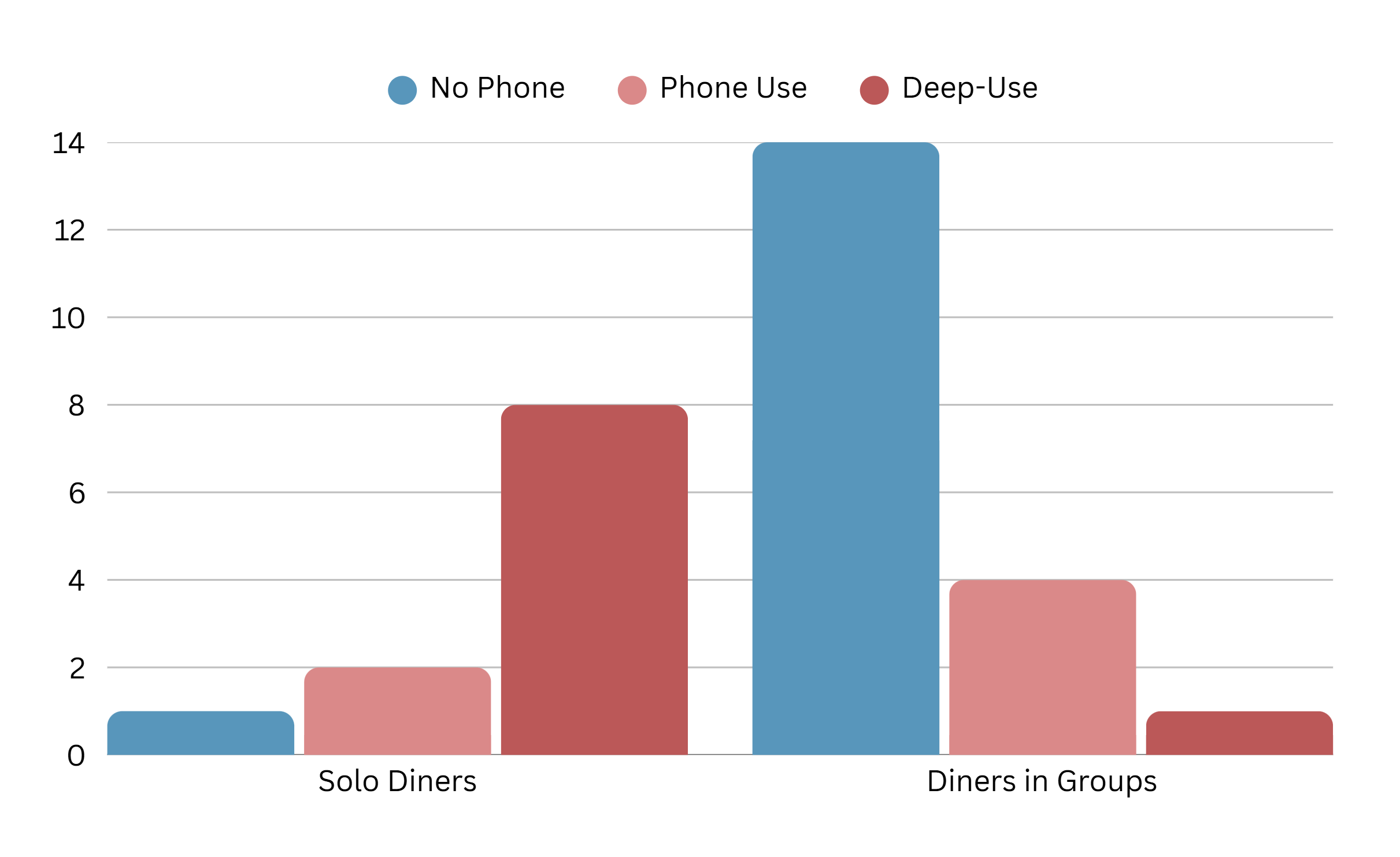
S - 1 SP - 10, (80% deep-use) G - 14 GP - 5, (20% deep-use)
It’s important to recognize that this observational study isn’t indicative of credible findings. It was improvised, contained a small sample size, and having been written on a napkin doesn’t convey professionalism either. However, I do believe it reveals some noteworthy insights.
The first insight is that my hypothesis was partially correct. 93.33% of solo diners were observed on their phones, and 80% scrolled or watched content during their entire stay (deep-use). However, the correlation flips when considering diners in groups, leading to the second insight: Out of 19 diners in groups, 26.32% were observed on a phone, and 5.26% (one diner) was suspected of deep-use of their phone. The data, albeit limited, indicate that eating alone correlates with sustained phone engagement, whereas eating with others significantly dampens it.
You don’t need to spend an hour watching people eat to determine that eating without stimulation is much more mundane than eating with others. This doesn’t just apply to enjoying a meal, but washing dishes, commuting, laundry, walking the dog, sorting mail, unraveling wired headphones, you name it. These in-between moments that are lost to phones are known as “interstitial time”.
“Interstices are gaps between things, as with the cells in your body or the spaces between architectural columns. When applied to time, it means the many bits of time scattered throughout the day, such as the five minutes that students have in between classes, or the unknown number of seconds that pass while you are waiting for an elevator.” This is how Jonathan Haidt defined interstitial time in his introduction to Christine Rosen’s essay, "On the Death of Daydreaming": In her essay, she explores the consequences of interstitial time being lost to phones.
While my focus is on social media’s relationship with children and adolescents, digital media impacts everyone’s day-to-day lives. According to Pew Research, Americans over the age of sixty “now spend more than half of their daily leisure time. . . in front of screens.” 87% of American teenagers own iPhones (Piper Sandler 2025). Apple products are state-of-the-art due to their proprietary silicon, performance, tightly integrated ecosystem, and high-quality screens. For adolescents, Apple has the majority market share, including among low-income households. With the accessibility of highly engineered phones, it’s clear that digital media is consuming interstitial time throughout the day. This is why having a healthy relationship with digital media is important. To ordinary people, interventions of phone use may not be the most accessible. What if, instead, a healthy relationship with phones is formed by appreciating life outside of screens? In theory, seeing beauty in life’s everyday mundanities weakens the pull of screens.
While direct research on the connection between mundanity and social media is mostly anecdotal, there are three reasons why a shift in perception of mundanity benefits an individual’s well-being. These pillars include: human tactility, creativity, and gratitude.
Our sense of touch starts to develop as early as eight weeks into pregnancy. As toddlers, we exert our curiosity through touch. We hold, squeeze, stretch, and experiment with how objects interact with the world around us. As we grow older, that curiosity becomes crucial to our survival. Without touch, we can’t receive feedback when interacting with the world around us. Our sense of touch remains in the background, providing a steady stream of information for our brains without requiring constant attention. Human tactility has remained true since humans were hunters and gatherers; however, it is a far different realm of stimulation than what digital technology poses. When we interact with screens, software simulates cause and effect through variable feedback loops to sustain attention with anticipation fluctuating through taps and presses. In other words, we don’t know if the next video will make us sad or laugh, we don’t know if a new text is from a crush or boss, we don’t know how many likes this new post will get. In a mundane world, every press of a button will have the same expected outcome. Manipulating physical objects healthily stimulates our age-old senses, whether through buttons and knobs from analog technologies or activities like building LEGOs.
*
One day, Albert Einstein gazed at the Bern tower on a streetcar ride, which prompted his theory of special relativity. Twenty-three years prior, Nikola Tesla went on a walk in a Budapest park and experienced an epiphany that led to the invention of the alternating electrical current. Einstein and Tesla’s scientific breakthroughs occurred during moments when they let their mind wander or daydream. In the first half of this paper, I claimed that being deprived of the Default Mode Network hinders our ability to build a rich understanding of our sense of self and the world around us. When we’re in the DMN, we engage in self-reflection, memories, daydreaming, and social evaluation. However, like Albert Einstein and Nikola Tesla, it’s also when we’re uniquely creative.
The opposite of consumption is creation. During mundane moments between commuting or doing chores, rather than watching content or even listening to music, let your mind wander. Zone out for a moment. Meditate on ideas and ponder on any existential thoughts that may surface. Digital media is an effective means of avoidance. If any negative thoughts or emotions surface, those are even more important to address internally. Let yourself become inspired to begin that project you’ve been meaning to start or pick up that book. The interstitial time that is consumed by watching content adds up. Watching content isn’t inherently wrong. There is a lot of creative content online; however, the abundance of creativity places the responsibility on the user to be intentional. You’d be surprised when creativity strikes whilst in everyday mundanities.
The last pillar is opposite to the second. Rather than letting your mind wander, the principle of this pillar is to relish the present moment. Mundane activities allow for deeper engagement with the task at hand, and it promotes mindfulness. Mindfulness is a big buzzword in self-help, and I think it’s worth defining. “Mindfulness is the basic human ability to be fully present, aware of where we are and what we’re doing, and not overly reactive. (mindful.org)” Personally, I’ve preached mindfulness for as long as I’ve been interested in psychology; however, I fail to apply it myself. Mindfulness reduces stress, benefits self-awareness and empathy, and is also disrupted by social media.
Activities like praying before a meal or crocheting, which have risen in popularity among Gen Z, provide the opportunity to practice gratitude. Gratitude is a key force behind happiness. While social media is great at showing us what we want, these practices of tactility, creativity, and gratitude help us appreciate what we have.
As someone born right alongside each iteration of the iPhone, I am among the first generation to grow up natively in the digital era. With the constant buzz of notifications, distraction, and influence online, embracing mundanity is an important reaction to digital media’s entanglement in our lives. Journaling, crocheting, and retro tech have all risen in popularity as a response. While self-help content encourages building healthy habits, I propose something arguably more difficult. I propose a shift in perception in daily life, one that values the mundane, not an escape from reality.
In conclusion,
Within the umbrella of preventative health, I’ve placed my focus on digital health for the past two years. While I am grateful to have grown up in the United States, from my point of view, living in a developed country doesn’t automatically entail happiness or good health. A foreign example is South Korea, the 12th-wealthiest country in the world, yet it has among the highest rates of suicide. Zooming closer to our community in the US, there are many valid obstacles to happiness in our lives. This paper was drawn from what I felt was the most universal obstacle to adolescents' well-being. Hopefully, after reading this paper, I’ve provided sufficient evidence to conclude that such an issue lies in the very palm of our hands.
I started this paper by prefacing digital media’s entanglement in our daily lives. While the absolute healthiest recommendation is to completely abstain from using social media and watching short-form content, I acknowledge that due to addiction or social circumstances, it’s not that simple. We must develop and sustain a healthy relationship with our phones, social media, and now AI.
For some, a healthy relationship entails optimizing your phone to add friction and screen time blockers. However, if I had only thirty seconds to advise a fellow peer, or if there was only one takeaway from this paper, it’s this: spend more time being bored.
I led with a startling statistic about meaning and purpose among Gen Z. The statistic reveals that many of us lack a sense of horizon. The inspiration for this paper originated from a pattern I observed where adolescents who experience a lack of meaning or purpose tend to be more immersed in social media. When we are deprived of boredom, we don’t allow ourselves the time and attention to be in the Default Mode Network, to be creative, and to ask the questions that guide our moral compass. Instead, we feel inadvertently lost or chronically bored.
Many habits and settings can reduce screen time. I’ve tried countless techniques, but based on my experience and anecdotes online, they never quite solve this problem. What I have found to be effective isn’t new habits, but to practice tactility, creativity, and gratitude—a shift in the perception of what we experience and avoid every day—mundanity.
In Kim Won-seok’s Korean dramas, there are many scenes where the main characters do mundane things like chores or glaring out the bus window. From a storytelling perspective, these writing decisions feel intentional, as being on a phone removes any potential for contemplative thinking. While our lives are not as dramatic, they’re stories that contain ups and downs. If we have a compulsion towards avoidance, the value of the sweet and bitter moments life has to offer will lose its meaning.
Practical Applications
*Minimize notifications
I recommend going into each app that sends notifications and disabling as many as possible. If a notification isn’t worth acknowledging, it’s not necessary to have it enabled. This reduces distractions.
Focus Modes
I only utilize Apple’s Focus Modes for Do Not Disturb and to disable vibrations, however its functionality is much more extensive. It can filter notifications and screen time for apps according to different times.
Detox
There is value in taking a period of time to quit phone or social media use. The benefits of a detox are felt less or end altogether when the break ends and phone use resumes, which is why I recommend having detoxes on a frequent basis.
*Tap to Wake, Raise to Wake Off
These two settings disabled are my favorite on this list. With these settings off, the only time the phone screen turns on is when you receive a notification or press the power button. When paired with Do Not Disturb, the phone is a brick and can be placed on a desk while working without any distraction. These settings allow the user to use the phone when they intentionally decide to, with minimal friction.
Turn FaceID Off
Another layer of friction, but it can be inconvenient.
Grayscale Mode
Removing color kills stimulation. I recommend turning it on during productivity, before bed, and in the morning. You can also automate the timing of its on/off cycles at set intervals.
Manage Screen Time
Having a system and app that sets a screen time limit on addictive or most-used apps is beneficial.
*Mornings and Nights are Crucial
The way you spend your morning determines your motivation for the rest of the day. The way you spend your day determines the quality and health of your sleep. Avoid using your phone four hours after you wake up and two-four hours before you go to bed.
*Go Outside, Socialize, and Embrace Mundanity
Best for your health.
Artifacts
Citations
McGrath, M. Nancy Reagan and the negative impact of the “Just Say No” anti-drug campaign. The Guardian, (2017, July 14).
https://www.theguardian.com/society/2016/mar/08/nancy-reagan-drugs-just-say-no-dare-program-opioid-epidemic
Devi, K. A., & Singh, S. D. The Hazards of Excessive Screen time: Impacts on Physical health, Mental health, and Overall well-being. Journal of Education and Health Promotion, 12(1), (2023).
https://doi.org/10.4103/jehp.jehp_447_23
Eastwood, J. D., Frischen, A., Fenske, M. J., & Smilek, D. The unengaged mind: Defining boredom in terms of attention. Perspectives on Psychological Science, 7(5), 482–495. (2012).
https://doi.org/10.1177/1745691612456044
Tam, K., & Inzlicht, M. People are increasingly bored in our digital age. Communications Psychology, 2(1), (2024).
https://doi.org/10.1038/s44271-024-00155-9
Perez, E. How Social Media Exploits Adolescent Neurology. (2025)
https://docs.google.com/document/d/e/2PACX-1vT0_bAv8UhYPxzbOs_Dgbo60Ua3fFCTOMpSys_90ihwK0GgHMmexh9zRvdYnileqJDLDA5nbF5nB4E-/pub
Viezzer, S. What Is The Default Mode Network?. SimplyPsychology, (2023, March 3).
https://www.simplypsychology.org/what-is-the-default-mode-network.html
Explore - Google Trends. Google.com, (2024).
https://trends.google.com/explore?q=vinyl%2520record%2520player%2Ccassette%2520player%2Cfilm%2520photography%2Cdumb%2520phone&date=all&geo=US
Vega, N. From Polaroid to vinyl, Gen Z is making retro tech one of 2025’s biggest trends: CNBC, (2025, March 15).
https://www.cnbc.com/2025/03/15/from-polaroid-to-vinyl-gen-z-is-embracing-retro-tech.html
The Future of Wellness: 2025 Trends. Global Wellness Summit, (2025, February 3).
https://www.globalwellnesssummit.com/product/2025-future-of-wellness-trends-report/
Radesky, J., Weeks, H., Schaller, A., Robb, M., Mann, S., & Lenhart, A. Constant Companion: A Week in the Life of a Young Person’s Smartphone Use. (2023)
Constant Companion: A Week in the Life of a Young Person's Smartphone Use Common Sense Media, (2023).
https://www.commonsensemedia.org/sites/default/files/research/report/2023-cs-smartphone-research-report_final-for-web.pdf
Piper Sandler. Taking Stock With Teens | Piper Sandler. pipersandler.com, (2022).
https://www.pipersandler.com/teens
Mindful Staff. What is Mindfulness?. Mindful., (2020, July 8).
https://www.mindful.org/what-is-mindfulness/
Author Last, First. Rethinking Analog: A Resurgence Of Tactile Technology | Blog | SIIT. Siit.co., (2024).
https://siit.co/blog/rethinking-analog-a-resurgence-of-tactile-technology/14763
Cashin, A. Beyond Work, Scroll, and Repeat: Cultivating Meaning and Purpose in Gen Z. Making Caring Common. (2024, May 23).
https://mcc.gse.harvard.edu/whats-new/gen-z-meaning-purpose
For Gen Z, A Sense of Purpose and Family Connection Contribute to Happiness. Psychiatry.org, (2024).
https://www.psychiatry.org/news-room/apa-blogs/for-gen-z-a-sense-of-purpose-and-family-connection
Finding Beauty in the Mundane: A Journey of Perception. Arcadia University. , Year.
https://www.arcadia.edu/student-life/meet-our-students/jj-demetrius-26/finding-beauty-in-the-mundane-a-journey-of-perception/
You Need to Be Bored. Here’s Why. Harvard Business Review, (2025, August 28).
https://hbr.org/2025/08/you-need-to-be-bored-heres-why
Haidt, J. The Anxious Generation: How the Great Rewiring of Childhood Is Causing an Epidemic of Mental Illness. Penguin Press, (2024).